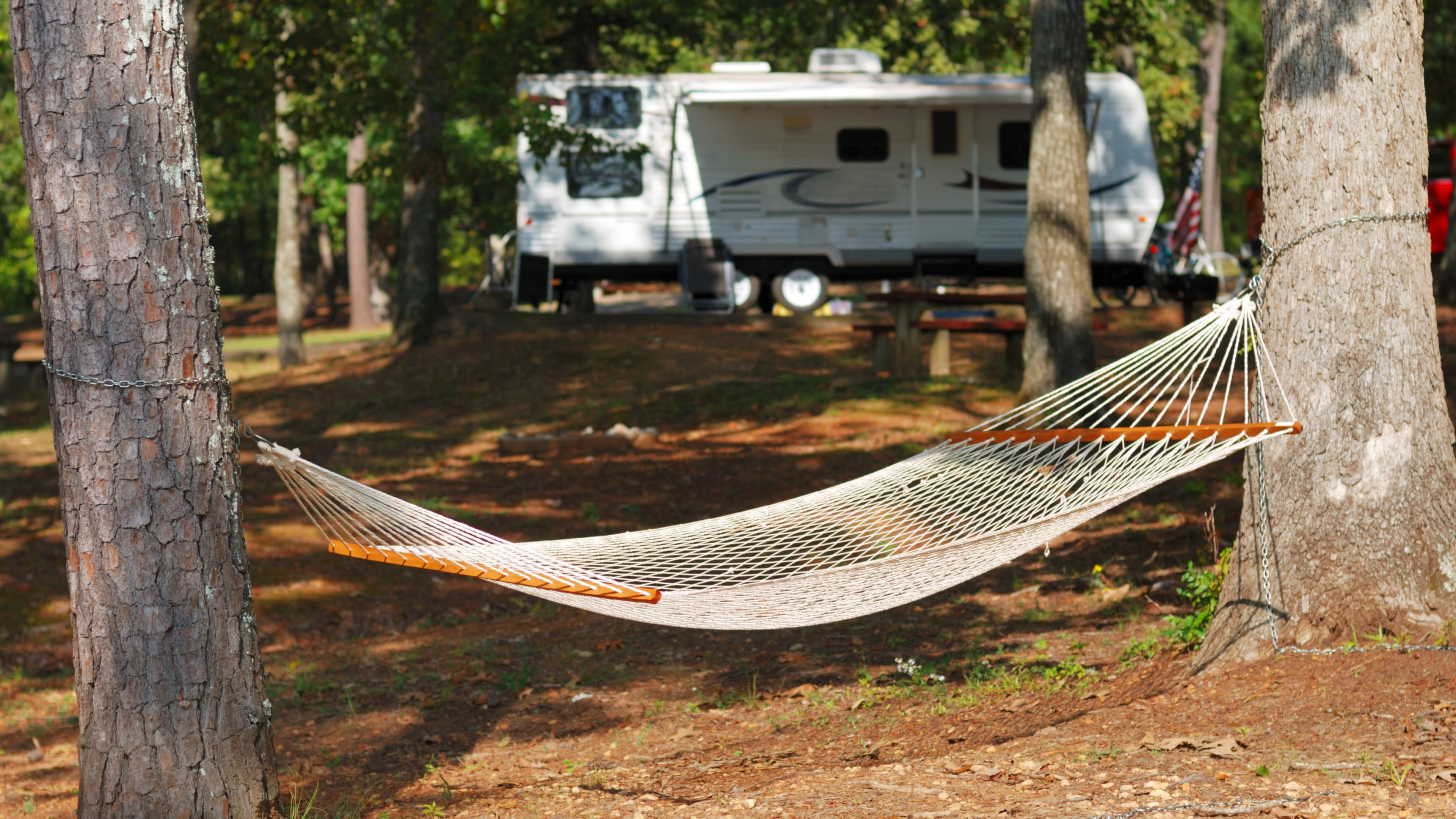
Geometry, weight, and land rules: what actually separates a flat, comfortable hang from a banana-shaped one.
Hammock camping tips fill the internet, but most stop at "hang at 30 degrees and use wide straps." That's not enough for a night in the backcountry. The real challenge is understanding how geometry, weight, insulation, land rules, and site selection all work together, and knowing which public lands actually welcome a hammock setup before you drive three hours to find out they don't.
This guide covers the complete overnight hammock system, the setup mechanics that matter, what your rig actually weighs, and where to find hammock-compatible campsites across US public land.
In this guide
- The geometry that makes or breaks a hammock night
- What a complete overnight hammock system actually weighs
- Tree straps, Leave No Trace, and why rope is the wrong choice
- Hammock camping on US public land: what's actually allowed
- Finding hammock-compatible sites before you go
- Regional hammock camping highlights on US public land
- Putting the Xpedition together
- Frequently asked questions
The Geometry That Makes or Breaks a Hammock Night
Most bad hammock nights trace back to setup, not gear. According to Onewind® Outdoors, 90% of setup failures come from just three mistakes, and most of them involve hang angle.
The target is a 30-degree strap angle from the tree to the hammock end. Live Outside describes the full geometry: 30-degree angle, an 18-inch sit height when you press down in the center, trees 12 to 15 feet apart, and your body angled 10 to 15 degrees off the centerline to flatten the lay. That diagonal position is what separates a banana-shaped, back-straining hang from a flat, comfortable sleep.
Get the angle wrong and the tension multiplies fast. Live Outside notes that a 200-pound sleeper in a near-flat hang can put more than 1,000 pounds of tension on each strap and carabiner. That's not a reason to avoid hammocks. It's a reason to use rated hardware and wide suspension straps, not thin cord.
Tree Selection
The trees do the structural work. Look for live, healthy trunks at least 6 to 8 inches in diameter. Dead trees, leaning trees, and anything with visible rot or hollow sections are not candidates, regardless of how convenient their spacing looks.
Public Lands notes that most hammock suspension systems fit trees spaced 10 to 20 feet apart. Closer than 10 feet and you can't achieve the right angle without hanging too low. Beyond 20 feet, your straps may not reach, or the tension geometry becomes unfavorable.
Also check for dead branches directly above your sleeping position. A widow-maker doesn't care that your hang angle was perfect.
Getting the Hang Right the First Time
Onewind® Outdoors found that first-time setup takes around 25 minutes and drops to about 10 minutes by the third trip. The learning curve is real but short. Before your first overnight, practice in the backyard or a local park: hang, sit, adjust, and lie down diagonally until the flat-lay position feels natural. Doing this at home means you're not problem-solving in the dark at camp.
What a Complete Overnight Hammock System Actually Weighs
A hammock alone is not a sleep system. For three-season and shoulder-season camping, you need four components: the hammock body, suspension straps, a tarp, and bottom insulation. A bug net is either integrated or a fifth piece.
Here's what a realistic ultralight-to-midweight system looks like:
- Hammock body: 12 to 20 oz for a single-layer gathered-end hammock
- Suspension straps (1-inch, 9-foot tree straps plus whoopie slings): 4 to 8 oz per pair
- Tarp (silnylon or DCF, 8 x 10 ridgeline coverage): 10 to 20 oz
- Underquilt (20°F rated): 16 to 28 oz
- Top quilt or sleeping bag: 16 to 26 oz
- Bug net (if not integrated): 4 to 8 oz
A complete ultralight system lands around 3 to 4 pounds. A midweight system with a warmer underquilt and heavier tarp runs 5 to 6 pounds. Compare that to a 3-season tent, footprint, and sleeping pad at 4 to 7 pounds: the weight case for hammocks is real, but not dramatic. The comfort and setup-speed case is often stronger.
For a detailed comparison of hammock systems against tent and bivy options in a full ultralight kit, the Ultralight Backpacking Gear Guide 2026 covers pack weight tradeoffs across sleep systems.
Bottom Insulation Is Not Optional
Cold air circulates under a hammock in a way it doesn't under a tent. Your sleeping bag compresses beneath you and loses most of its insulating value. An underquilt suspends insulation below the hammock body, keeping warm air trapped against your back and legs.
Below 50°F, an underquilt is not a comfort upgrade. It's what keeps you from waking up cold at 2 a.m. For summer camping in the Southeast or Southwest, a foam sit pad slid under your lower back is often enough. For anything else, budget for a proper underquilt.
Tree Straps, Leave No Trace, and Why Rope Is the Wrong Choice
The rule is simple: use wide, flat tree straps, not rope or thin cord. Rope concentrates force on a narrow band of bark and cambium. Wide straps distribute that load across a larger surface area and cause far less damage.
The standard recommendation is straps at least 1 inch wide, though many land managers and Leave No Trace guidelines now recommend 2-inch straps, particularly in high-use areas. Some parks and campgrounds specify minimum strap width in their rules. Check before you go.
Campendium noted in its 2022 report that hammocks are allowed in most US national parks, though some parks require tree protection or specify strap thickness. That "most" carries weight: it means some don't, and the rules vary enough that assuming permission is a mistake.
The same 2022 Campendium report recommends hanging at least 200 feet from fragile shorelines and water sources, a standard that aligns with Leave No Trace principles for campsite selection generally. Public Lands echoed this in its 2024 report, recommending the same 200-foot buffer from water sources for hammock setups.
Hammock Camping on US Public Land: What's Actually Allowed
This is where most hammock guides go quiet. The rules differ significantly by land type, and knowing the difference before you plan a trip saves real frustration.
National Parks
Hammock camping is generally permitted in designated campsites within national parks, but rules vary by park. Some, particularly those with fragile or recovering ecosystems, restrict hammock use in certain zones or require specific strap types. A few high-traffic parks have banned hammocks in day-use areas entirely.
The safest approach: check the specific park's regulations page before your trip, not a general "hammocks are allowed in national parks" summary. Call the ranger station if the website is ambiguous. Rangers are consistently helpful on this question.
National Forests
National forests managed by the US Forest Service are generally the most permissive public land for hammock camping. Dispersed camping is allowed in most national forests without a permit, and hammock use in dispersed areas faces few restrictions beyond Leave No Trace principles and the standard 200-foot water buffer.
High-use areas and wilderness zones within national forests may have additional rules. Some wilderness areas require camping at designated sites or a set distance from trails and water.
BLM Land
Bureau of Land Management land follows similar logic to national forests: dispersed camping is broadly permitted, and hammock use is generally unrestricted as long as you're following Leave No Trace principles and any site-specific rules. BLM land is often the most accessible option for hammock camping in the West, particularly in areas with mature ponderosa pine, juniper, and cottonwood stands along river corridors.
State Parks and Campgrounds
State park rules vary more than any other category. Some explicitly welcome hammock camping and have designated hammock-friendly sites. Others prohibit hanging from trees entirely to protect high-use areas. Check the specific park's website and, if unclear, call.
Campground-specific rules sometimes go further than the land agency's general policy. A national forest campground with a host may have posted rules that restrict hammock hanging even where the broader forest allows it.
Finding Hammock-Compatible Sites Before You Go
The practical problem is not knowing the rules in the abstract. It's finding specific sites where the trees, spacing, terrain, and regulations actually align.
A few reliable approaches:
- Search for hardwood or mixed forest zones. Mature hardwood forests in the Appalachians, Ozarks, and upper Midwest offer consistent tree spacing and healthy trunk diameter. Conifer forests in the Rockies and Pacific Northwest are often viable but require more scouting.
- Use satellite imagery before arrival. Google Earth or a mapping app with satellite layer lets you assess tree density and spacing from home. Look for canopy gaps that suggest appropriate tree spacing rather than dense or open stands.
- Filter for dispersed camping areas. National forest and BLM dispersed camping zones give you the most flexibility. Apps that show dispersed camping boundaries are useful for narrowing down areas worth scouting.
- Check elevation and season. Higher elevations mean colder nights and potentially stronger wind. A hammock tarp rated for three-season use handles most conditions, but exposed ridgeline sites in shoulder season require more attention to weather protection.
For planning a multi-day hammock Xpedition with multiple campsites, resupply stops, and driving legs between trailheads, the guide on planning a multi-day backcountry trip with campsites and resupply covers the coordination workflow in detail.
Regional Hammock Camping Highlights on US Public Land
A few areas consistently deliver the tree spacing, canopy, and land access that hammock campers need:
Ozark National Forest, Arkansas. Mature oak and hickory forest with consistent tree spacing, dispersed camping throughout, and relatively mild shoulder seasons. One of the most underrated hammock destinations in the country.
George Washington and Jefferson National Forests, Virginia and West Virginia. Dense hardwood canopy along the Appalachian ridge, proximity to the AT corridor, and abundant dispersed camping. Tree spacing is reliable across most of the forest.
Shawnee National Forest, Illinois. Sandstone bluffs, hardwood hollows, and dispersed camping with good tree density. The Garden of the Gods wilderness area is a standout for hammock camping.
Ouachita National Forest, Arkansas and Oklahoma. Mixed pine-hardwood forest with long-distance trail access and dispersed camping. The Ouachita Trail is particularly well-suited to hammock-based through-trips.
Pisgah and Nantahala National Forests, North Carolina. High-elevation hardwood forest, reliable tree spacing, and proximity to the Blue Ridge Parkway. Shoulder seasons are cool enough to require an underquilt but offer some of the best canopy in the East.
Coconino National Forest, Arizona. Ponderosa pine forest around Flagstaff at elevation, with dispersed camping and good trunk diameter. Nights are cold even in summer at 7,000 feet, so plan accordingly.
In the West, BLM land along river corridors in Utah, Colorado, and New Mexico often has mature cottonwood and box elder stands that work well for hammock camping, particularly in canyon country where tent camping on rocky ground is impractical.
Putting the Xpedition Together
Hammock camping adds a layer of site-specific planning that tent camping doesn't require. You're not just finding a flat spot. You're finding the right trees, confirming land rules, checking strap requirements, and sequencing it all within a multi-day trip that includes driving legs, trailheads, and resupply stops.
Xavier, the AI agent companion at xploreum.io, builds complete outdoor Xpeditions around your starting point, destination, group size, skill level, and preferred camping style. Describe the trip in plain language and Xavier organizes routes, campsites, driving legs, and activity stops into one connected Xpedition with an interactive map, including waypoints you can open directly in your preferred navigation app. For hammock-specific trips, that means coordinating the trailhead approach, dispersed camping zones, and overnight stops in a single view rather than across four separate apps.
The best apps for hiking and camping trip planning guide covers how different tools handle the planning workflow, including where an AI agent companion fits alongside mapping and navigation apps.
Frequently asked questions
What is the correct hang angle for a hammock?
The target is a 30-degree angle from the tree to the hammock end. Live Outside describes this as the key geometry number, paired with an 18-inch sit height when you press down in the center and your body angled 10 to 15 degrees off the centerline for a flat lay.
How far apart should trees be for hammock camping?
Public Lands noted in its 2024 report that most hammock suspension systems fit trees spaced 10 to 20 feet apart. Closer than 10 feet makes the correct hang angle difficult to achieve. Beyond 20 feet, your straps may not reach or the geometry becomes unfavorable.
Do you need an underquilt for hammock camping?
In temperatures below 50°F, yes. Your sleeping bag compresses under your body weight and loses most of its insulating value. An underquilt suspends insulation below the hammock fabric where compression can't reduce it. For summer camping in warm climates, a foam pad under your lower back is often sufficient.
Are hammocks allowed in US national parks?
Campendium noted in its 2022 report that hammocks are allowed in most US national parks, though some parks require tree protection or specify minimum strap thickness. Rules vary by park and zone. Check the specific park's regulations page or call the ranger station before your trip.
What straps should you use for tree protection?
Use flat, wide straps rather than rope or thin cord. The minimum is 1 inch wide; 2-inch straps are better in high-use areas and are required by some land managers. Wide straps distribute load across more bark surface and cause significantly less damage to the tree.
How do you find hammock-compatible dispersed camping sites?
Search for mature hardwood or mixed forest zones using satellite imagery before arrival. National forest and BLM dispersed camping areas in the eastern US offer the most consistent tree spacing. Check land agency rules for the specific area, confirm the 200-foot water-source buffer applies, and look for canopy gaps that suggest appropriate spacing rather than dense or open stands.
How much does a complete overnight hammock system weigh?
A complete ultralight hammock system, hammock body, straps, tarp, underquilt, and top quilt, runs approximately 3 to 4 pounds. A midweight system with a warmer underquilt and heavier tarp lands around 5 to 6 pounds. The weight is comparable to a 3-season tent setup, with the comfort and setup-speed advantages often making the stronger case.