
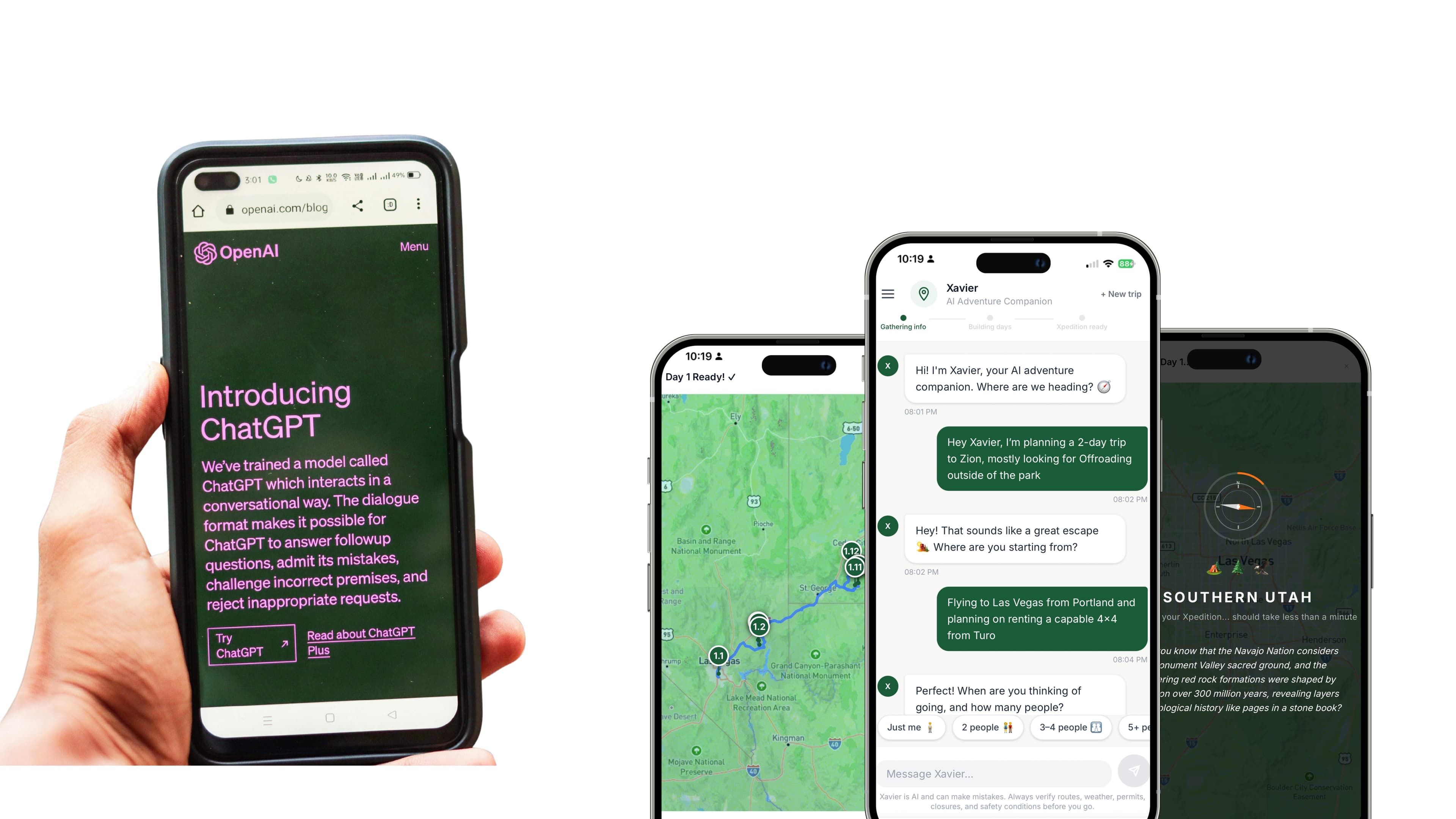
ChatGPT is a powerful general-purpose assistant. Xavier is a purpose-built AI companion for outdoor adventures. The better choice depends on whether you need ideas or a trip structure designed around routes, waypoints, terrain, and local support.
Quick verdict: Choose Xavier for an outdoor Xpedition. Choose ChatGPT for broad research and brainstorming. Xavier is built to turn a conversation into a structured adventure plan with routes, stops, campsites, and a local Xpert layer. ChatGPT can produce excellent ideas and research, but the traveler usually has to organize and verify the execution details.
Side-by-side comparison
This table focuses on the workflow travelers need after the initial idea: turning preferences into an outdoor-ready trip structure.
| Feature | Xavier (Xploreum) | ChatGPT |
|---|---|---|
| End-to-end trip building | Yes | Partial |
| Local Xpert integration | Yes* | No native Xpert network |
| Outdoor trip map and waypoints | Yes, routed legs and stops; Xplorer Pro hands a stop to Apple Maps or Google Maps on mobile | No dedicated trip map |
| Outdoor routes and waypoints | Yes, core workflow | Can suggest, but requires manual transfer and verification |
| Research inside the plan | Yes, gathered as the Xpedition is built | Yes, strong general web research with citations |
| Saved trip workspace | Yes, Xpedition itinerary and map | Saved chat, not a purpose-built outdoor itinerary |
| Best use case | Outdoor adventure planning and execution | General travel questions and idea generation |
*Xpert coverage and offline or navigation features can vary by destination, device, and product release. Verify current in-app availability before departure.
A dedicated travel system vs. a general AI assistant
Xavier is built around the trip object. It asks for the details that change an outdoor plan: dates, starting point, budget, skill level, comfort, activity, vehicle, and the kind of experience you want. The output is an Xpedition, not only a block of text.
ChatGPT is built around the conversation. It can search, reason, compare options, and produce a detailed itinerary. Its strength is flexibility. The tradeoff is that route data, bookings, maps, and trip execution usually remain separate tasks.
Where Xavier is stronger
1. Outdoor-specific planning
Adventure trips are constraint-heavy. A route that looks reasonable on a map may fail because of access restrictions, seasonal closures, water availability, resupply timing, or technical difficulty. Xavier is designed to keep these adventure-specific considerations inside one planning flow.
2. Routes, waypoints, and day-by-day structure
Instead of stopping at a written itinerary, Xavier organizes a trip around practical stops: trailheads, campsites, fuel, food, rentals, stays, and route legs. That makes the plan easier to review and use than a long conversational answer.
3. Local Xpert context
Xploreum's differentiating layer is its network of local Xperts, including guides, lodge operators, gear providers, and other people who know the destination. Coverage is expanding, but the model is built around connecting AI planning with real local knowledge.
Where ChatGPT is stronger
1. Broad destination research
ChatGPT is excellent when the question is open-ended: comparing countries, understanding history, translating phrases, generating restaurant shortlists, or summarizing current web sources. OpenAI's search experience can return timely answers with citations and, in some mobile contexts, map-based results.
2. Flexible reasoning across unrelated topics
A general assistant can help with almost any adjacent question, from drafting a visa checklist to explaining camera settings. Xavier is intentionally narrower because its product value is the adventure-planning infrastructure underneath the conversation.
3. Early-stage brainstorming
For travelers who do not yet know what kind of trip they want, ChatGPT can be a useful blank canvas. Once the goal becomes a practical outdoor itinerary, a dedicated planner becomes more valuable.
Best combined workflow: use a general AI assistant to explore broad possibilities, then build the chosen outdoor trip in Xavier so the route, waypoints, campsites, and local context live together.
Can ChatGPT plan a complete trip?
It can create a detailed plan, and its web search can improve freshness. But "complete" has two meanings. ChatGPT can complete a written itinerary. A dedicated travel product is better positioned to complete the structured workflow around that itinerary: persistent stops, maps, route legs, provider context, and in-trip access.
This is also why verification matters. Travel planning combines many constraints and changing facts, and even strong models can struggle with feasibility, implicit requirements, and correcting their own mistakes. Treat any AI-generated itinerary as a starting point, not a substitute for checking primary sources.
Who should choose Xavier?
- Hikers, campers, backpackers, overlanders, mountain bikers, and outdoor travelers.
- People planning multi-stop or multi-day trips with route and logistics dependencies.
- Travelers who want a coherent Xpedition rather than notes scattered across chats, maps, and spreadsheets.
- People who value local-provider context and destination-specific knowledge.
Who should choose ChatGPT?
- Travelers who mainly need ideas, research, translation, or a flexible written itinerary.
- People planning urban or general leisure trips without complex route logistics.
- Travelers who want one assistant for travel plus many unrelated tasks.
Turn what you read into a trip.
Bring the route, campsites, and stops together with Xavier.
Frequently asked questions
Is Xavier better than ChatGPT for travel?
Xavier is a better fit for outdoor adventure trips that need routes, waypoints, campsites, and local Xperts. ChatGPT is a better fit for broad research, brainstorming, and general questions.
Can ChatGPT create a complete travel itinerary?
Yes, ChatGPT can draft detailed itineraries and use web search for current information. Travelers still need to verify facts and organize execution details that are not stored in a dedicated trip workspace.
Can Xavier plan hiking, camping, and overlanding trips?
Yes. Xavier is designed around outdoor Xpeditions, including routes, waypoints, campsites, resupply, stays, and local services.
Does either tool replace safety checks?
No. Always confirm permits, closures, weather, fire restrictions, avalanche or flood conditions, operating hours, reservations, route difficulty, and emergency information with authoritative sources.
Sources
- Xploreum: Xavier product overview and Xpedition workflow
- OpenAI: ChatGPT Search documentation
- OpenAI: Introducing ChatGPT Search
- Princeton University: Generative Engine Optimization research
If you would rather compare dedicated planning apps than general assistants, see the best AI trip planners for outdoor adventures in 2026 and the best apps for planning and booking hiking and camping trips end to end.